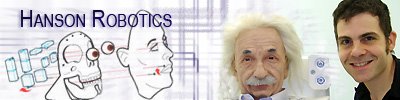
 David Hanson is the proud creator of what I call the monster of Isaac Asimov! For fans of SF literature, this name is a reference for others I hope it will be. Implications
scientific, artistic, and moral are the three main ideas underlying the design of the androids Hanson Robotics Inc. .
Make no mistake: D. Hanson built the robot did not complete but only Einstein's face (the body is that of the famous robot designed by SONY QRIO ).
Unlike other robots, it proudly displays a human figure, which ranks in the "android" in fact, that face, besides being true to human traits, has the power to restore a feeling! Here a video that you will better appreciate this technological advance.
This artificial skin could be made from an elastomer material, as the compression of this material is far too low and requires enormous amounts of energy compared to that provided by the batteries of the robot. Human skin is composed mainly of water, which makes it so resilient. He had to find a material that can reproduce this feature: it was the porous elastomer deposited under the brand Frubber (Flesh Rubber, translate: "flesh rubber") which was adopted. Its uniqueness is that it stretches like rubber and is compressed as the foam, the result is a face wrinkles and folds much more naturally. And the big plus is that Frubber consumes only 10 watts of power over 3700 watts used to deform other types of polymers! Result of Einstein's face is self-powered and does not pump energy to the battery which serves to move!
And behind this little face hides a humanoid technology. Here's another video that shows the incredible capabilities of these mechanical faces to mimic human expressions. Movements the skin are operated by cables, themselves controlled by servomotors.
But why stop at mimicry? Let him speak that Einstein! And that is what he is: able to answer a series of questions (which he knows the answers in advance ... do not push it either), it shows us that the hearing and speech are part of design. In this regard, the technology used to render the information contained in its database, word is TTS (see previous article on this blog). It also has a recognition system face, which keeps the speaker in his field of vision.
 So, we wait with impatience the arrival of turnkey android Post, who smiles all the time and does not close his office at 17:00 when everybody bump
In any case, the 21st century seems to be indeed the era of technological upheaval as expected for over 20 years.


0 comments:
Post a Comment